
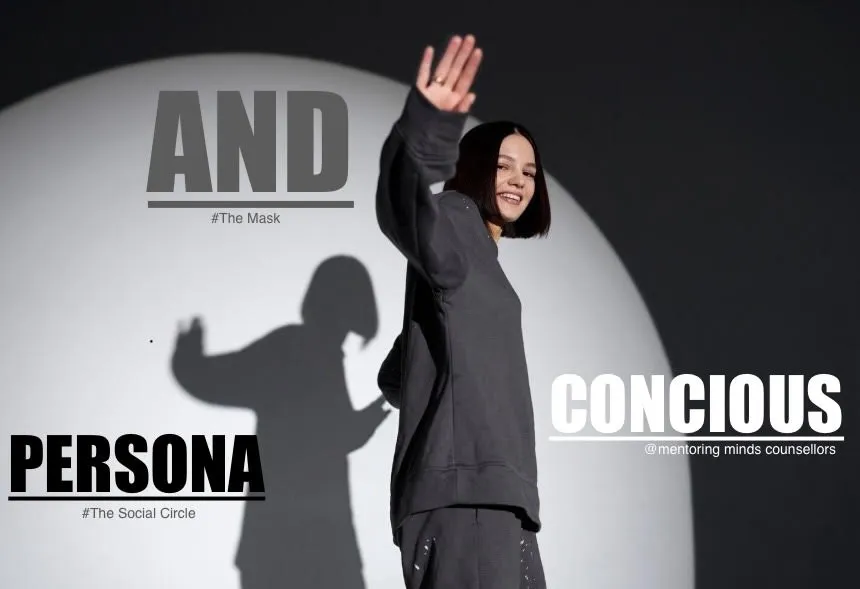
Have you ever noticed that you behave differently depending on where you are and who you are with?
At work, you might be disciplined, formal, and highly focused. With close friends, you may become playful and relaxed. Around your parents, you might unconsciously return to habits you had years ago. Yet despite all these changes, there is still a feeling that “you” remain the same person.
This two fascinating concepts: persona and consciousness.
What Is a Persona?
A persona is the identity we present to the outside world. It is the collection of behaviors, attitudes, communication styles, and characteristics that we display in different situations.
Think of a persona as a social mask not a dishonest mask, but a practical one.
Imagine a doctor working in a hospital. While treating patients, the doctor speaks calmly, appears confident, and maintains professionalism even during stressful situations. This professional image is part of the doctor’s persona.
Now imagine the same doctor at home. They may joke with their children, complain about a difficult day, or express fears and insecurities. The professional persona is still part of them, but it is not the whole person.
The persona helps us function effectively in society. Without it, social interactions would become chaotic. Different situations require different forms of behavior.
Why Do We Create Personas?
Humans are social beings. From childhood, we learn which behaviors are rewarded and which are discouraged.
A child who is praised for being responsible may begin to develop a “responsible person” persona. Another child who receives attention for being funny may develop a “comedian” persona.
As we grow older, these identities become stronger. Society also encourages us to create personas:
- Professional personas for work.
- Social personas for friendships.
- Public personas for social media.
- Family personas for relatives.
None of these are necessarily false. They simply represent different aspects of ourselves.
The challenge begins when we forget that a persona is only a part of who we are.
What Is Consciousness?
Consciousness is much deeper than persona.
Consciousness is the awareness that experiences life.
It is the part of you that notices:
- Your thoughts.
- Your emotions.
- Your memories.
- Your fears.
- Your desires.
Right now, as you read these words, there is an awareness observing them. That awareness is consciousness.
To understand this more clearly, consider this question:
Can you observe your thoughts?
Most people would answer yes.
If you can observe your thoughts, then the observer and the thoughts cannot be exactly the same thing.
Similarly:
- You can observe your emotions.
- You can observe your beliefs.
- You can observe your social roles.
Let’s see an Example
Imagine you are watching a movie.
The characters in the movie experience joy, sadness, fear, and excitement. The story changes constantly.
However, the screen remains unchanged.
In this analogy:
- The movie represents your thoughts, emotions, and personas.
- The screen represents consciousness.
The scenes come and go.
The screen remains.
Likewise, throughout life, your identity changes.
At age ten, you had one personality.
At twenty, another.
At forty, another.
Your beliefs, appearance, and circumstances may change dramatically.
Yet there remains a continuous sense of “I am.”
That enduring awareness is consciousness.
When Persona Becomes a Prison
Problems occur when people become completely identified with a persona.
Consider a successful business executive.
For years, their identity revolves around being powerful, productive, and respected.
Then retirement arrives.
Suddenly, the title disappears.
The office is gone.
The authority is gone.
Many people experience a deep crisis during such transitions because they have confused their persona with their entire identity.
They unconsciously believed:
“I am my job.”
But a job is a role.
A role is a persona.
When the role disappears, the deeper self remains.
The same thing can happen with:
- Wealth.
- Fame.
- Physical beauty.
- Social status.
- Academic achievement.
When these external identities change, people may feel lost because they never explored who they were beneath them.
Social Media and Modern Personas
Social media has amplified the importance of persona.
Many people carefully curate an online identity.
They share:
- Successes.
- Vacations.
- Achievements.
- Happy moments.
Over time, maintaining this image can become exhausting.
A person may appear happy online while privately feeling lonely or anxious.
The conflict occurs because the public persona and inner experience are no longer aligned.
The larger the gap between them, the more psychological strain a person may experience.
How Consciousness Creates Freedom
Consciousness allows us to step back and observe our personas.
Instead of saying:
“I am an angry person.”
We begin to notice:
“I am experiencing anger.”
Instead of saying:
“I am a failure.”
We notice:
“I am having thoughts about failure.”
This subtle shift changes everything.
The emotion or thought is no longer controlling our entire identity.
We recognize it as an experience passing through awareness.
This creates psychological freedom.
We stop being trapped by temporary states and social labels.
Living with Both Persona and Consciousness
The goal is not to destroy the persona.
A healthy persona is necessary.
We need professional identities, social roles, and responsibilities.
The key is remembering that these roles are tools, not our ultimate identity.
A conscious person can fully engage in life while understanding that every role is temporary.
They can be:
- A parent without losing themselves in parenthood.
- A leader without becoming addicted to authority.
- A professional without defining their entire worth through work.
They use personas when needed while remaining aware of the deeper consciousness beneath them.
Final Reflection
Think of life as a stage.
The persona is the character you play.
The world sees the character.
Consciousness is the actor playing the character.
The actor may perform hundreds of roles during a lifetime, but none of those roles completely define who they are.
We at Mentoring Minds Counsellors believe that Understanding the difference between persona and consciousness is not about rejecting society or abandoning responsibilities. It is about remembering that while roles change, the awareness experiencing those roles remains.
And perhaps true self-understanding begins the moment we realize that we are not merely the masks we wear, but also the silent observer behind them.
Leave a Comment